NSFAS N+2 Rule Explained: Funding Limits and Appeals Guide
Many students search for the NSFAS N+2 rule because they fear funding may end before completing their qualification. Much of the information online, however, is outdated.
Under the 2026 NSFAS bursary guidelines, most funded students fall under the N+1 rule, while students with disabilities qualify for N+2. These periods apply once across a student’s academic career. Students who reach their limit may appeal in specific circumstances, but approval is not guaranteed.
Learn the NSFAS N+2 Rule, funding limits, study-year calculations, appeal options, and what happens when you exceed the allowed funding period in 2026.
What Does the NSFAS N+ Rule Mean?
“N” represents the official minimum time required to complete a qualification. The number added after N is the extra period NSFAS may fund.
For example:
A three-year qualification has an N value of three.
A four-year qualification has an N value of four.
A one-year qualification has an N value of one.
Most students receive N+1. A three-year qualification may therefore be funded for up to four years, while a four-year qualification may receive up to five years. Students with disabilities receive N+2, allowing up to five years for a three-year qualification or six years for a four-year qualification.
The extra period does not restart when a student changes courses or institutions.
Is NSFAS N+2 Rule Available to Every Student?
No. Automatic NSFAS N+2 Rule funding mainly applies to students with disabilities. Most other students receive N+1.
A non-disabled student who reaches N+1 may appeal for an additional academic term. If approved, this may move the student into the commonly described N+2 period. Students with disabilities may have limited appeal options before N+3.
An appeal requires valid grounds, evidence and, in some cases, confirmation that the student can finish within the extra term. Students who have completed N+2, or N+3 when living with a disability, are generally not allowed to appeal again.
How University Study Years Are Counted
For university students, NSFAS generally considers the number of years registered in higher education. A registered year may count even when the student:
A privately funded year can therefore reduce the NSFAS-funded time remaining.
Do Gap Years Count?
A full year in which the student was not registered does not automatically count simply because time passed.
A year may still affect the calculation if the student registered and later deregistered or had incomplete records. Students should request their registration history if the calculation appears incorrect.
How TVET Study Time Is Counted
TVET calculations work differently. The N+ rule is generally based on NSFAS-funded academic terms rather than every year spent in higher education. TVET students should track funded terms, previous programmes, repeated subjects, programme changes and funding received at another college.
The additional term may be used when repeating a level between the programme’s entry and exit stages.
Does Changing Courses Reset the N+ Clock?
No. Changing qualifications does not erase previous academic history. NSFAS considers the normal duration of the new qualification together with the time already used. The N value may change if the new qualification has a different duration, but previous registered years remain relevant.
For example, a student who uses two years in one programme and then transfers will not start from zero. If the remaining funding period is insufficient to finish the new course, funding may stop. Students should request a funding-duration calculation before transferring.
Moving Between University and TVET
Changing from a university to a TVET college, or the other way around, does not create a new additional year. The N+ extension applies once across the student’s academic career.
Previous history may affect remaining funding, progression, the new qualification’s eligibility and whether another application is required.
Does SASSA Status Add Funding Years?
No. Qualifying SASSA beneficiaries may meet NSFAS financial-eligibility requirements, but SASSA status does not extend the N+ period.
Students must still meet the funding limit, academic progression rules, registration requirements and qualification conditions. Financial eligibility and study-duration eligibility are separate assessments.
Academic Progress Requirements
Remaining within N+1 or NSFAS N+2 Rule does not guarantee continued funding. Students must also meet academic progression requirements. Continuing university students must generally pass at least 50% of their registered modules during the academic year.
Continuing TVET students must generally pass at least 70% of their modules or courses. Additional requirements may include passing at least five subjects to progress to the next NC(V) level or three subjects to progress to the next Report 191 level.
The 50% rule therefore does not apply to every NSFAS-funded student.
Can You Appeal an N+ Decision?
Students may appeal only when their circumstances meet NSFAS criteria.
Possible grounds include:
Severe illness lasting at least two consecutive months during the academic term or examinations
Death of an immediate family member
Being affected by a serious violent crime
Disability-related circumstances supported by a medical report
Incorrect academic results submitted to NSFAS
Being close enough to completion that the institution confirms the qualification can be finished within an additional term
A statement such as “I struggled” or “I need another chance” is usually not enough. The appeal must connect a documented event to delayed progress.
What Happens When You Exceed the Limit?
When NSFAS determines that a student has exceeded the applicable N+ limit, funding may stop. The student may lose tuition support, registration assistance, accommodation, living, transport and learning-material allowances.
Students should read the full myNSFAS decision and then:
Final-Year Appeal Requirements
Students close to completing their qualification may have a stronger appeal route. A university student may be considered when no more than 50% of final-year course credits remain and the institution confirms completion is possible within one additional term.
A TVET student may be considered when two or fewer subjects remain for a Report 191 qualification, or three or fewer subjects remain for an NC(V) qualification.
These conditions do not guarantee approval; they only make the appeal eligible for consideration.
Appeal Deadline and Process
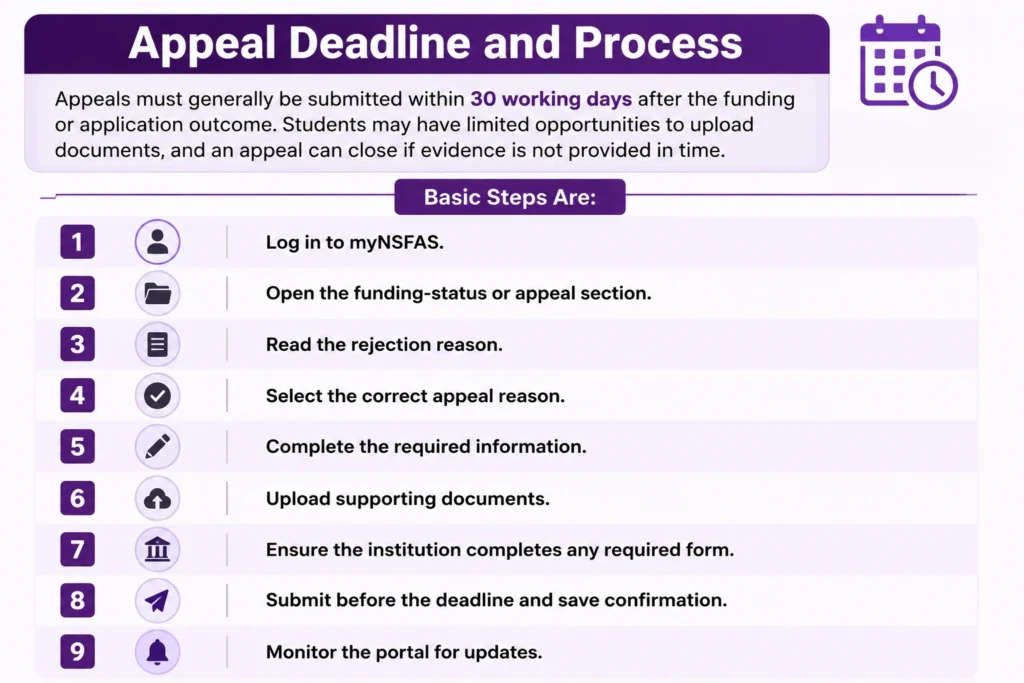
Appeals must generally be submitted within 30 working days after the funding or application outcome. Students may have limited opportunities to upload documents, and an appeal can close if evidence is not provided in time.
Basic steps are:
Log in to myNSFAS.
Open the funding-status or appeal section.
Read the rejection reason.
Select the correct appeal reason.
Complete the required information.
Upload supporting documents.
Ensure the institution completes any required form.
Submit before the deadline and save confirmation.
Monitor the portal for updates.
Supporting Documents
Documents depend on the appeal reason and may include:
Only relevant evidence should be uploaded.
Simple Appeal Motivation
Subject: Appeal Against N+ Funding Decision
Dear NSFAS Appeals Committee,
I request reconsideration of the decision that I exceeded my applicable N+ funding period.
During the [year or academic term], my progress was affected by [brief documented circumstance]. The attached documents confirm the situation.
I currently have [number] modules, credits or subjects remaining. My institution has confirmed that I can complete my qualification within [academic period].
I respectfully request that my funding eligibility be reconsidered based on the attached evidence.
Kind regards,
[Full name]
[Student number]
[Institution]
The motivation must match the student’s real circumstances and evidence.
Special Cases
For students at a non-contact distance university, the N period may be calculated as double the qualification’s minimum completion time before the additional period is applied.
An extended programme does not automatically change the original minimum duration used for the N calculation. The standard N+ rule may not apply to some occupational programmes because their duration is linked to employment contracts that do not provide an additional study period.
How to Protect Your Funding
Students should check registered modules, correct errors quickly, keep copies of results and decisions, seek academic support early, and discuss course changes with the financial-aid office.
They should also keep medical or official evidence when serious circumstances affect their studies and monitor myNSFAS throughout the year.
NSFAS N+2 Rule FAQs
Conclusion:
The phrase “NSFAS N+2 rule” is widely used, but it is not the automatic rule for every student.
Most students receive N+1, while students with disabilities receive N+2. University calculations generally use registered higher-education years, while TVET calculations focus on NSFAS-funded academic terms. Changing courses or institutions does not erase previous history, and SASSA status does not add funding time.
Appeals normally must be submitted within 30 working days and require evidence. Students should confirm their calculation with NSFAS and their institution’s financial-aid office.