NSFAS Appeal Process Explained: How to Submit Your Appeal?
If your NSFAS application was rejected, you can submit an appeal through your myNSFAS account. The appeal gives you a chance to explain your situation, upload proof, and ask NSFAS to review your funding decision again.
Do not wait too long. NSFAS appeals must be submitted within the allowed appeal window after your outcome appears. Learn the NSFAS appeal process for 2026. Follow these simple steps to submit your appeal, check your status, avoid common mistakes, and improve your chances.
What Is an NSFAS Appeal?
An NSFAS appeal is a formal request asking NSFAS to reconsider a rejected funding application. This does not mean every rejection can be changed. It means NSFAS will look again if you have a valid reason and proper documents.
You may appeal if your application was declined because of financial changes, wrong information, missing documents, academic problems caused by serious circumstances, or incorrect records from your institution.
Who Can Submit an NSFAS appeal process?
You may be able to appeal if:
Your household income recently changed
A parent or guardian lost a job
The main income earner passed away
You are a SASSA beneficiary but were marked ineligible
Your documents were missing or incorrect
Your academic results were affected by illness, trauma, pregnancy, or death in the family
Your university or TVET college submitted wrong academic or registration details
Your appeal must match the rejection reason shown on your myNSFAS profile.
Who Cannot Appeal?
Some cases are usually not appealable. You may not be able to appeal if:
If your case is not appealable, speak to your financial aid office about other bursaries or payment options.
Common NSFAS Appeal Reasons
Here are the main reasons students appeal:
| Reason | Proof You May Need |
| Parent lost job | Retrenchment letter, UIF proof, recent payslip |
| Parent passed away | Death certificate |
| Household income changed | New income proof or affidavit |
| SASSA mismatch | SASSA confirmation letter |
| Academic issue due to illness | Medical report |
| Pregnancy affected studies | Clinic card or birth record |
| Crime or trauma affected studies | Police report or professional letter |
| Wrong academic record | Correct transcript from institution |
| Missing documents | Clear updated documents |
The strongest appeal is not emotional. It is clear, honest, and supported by proof.
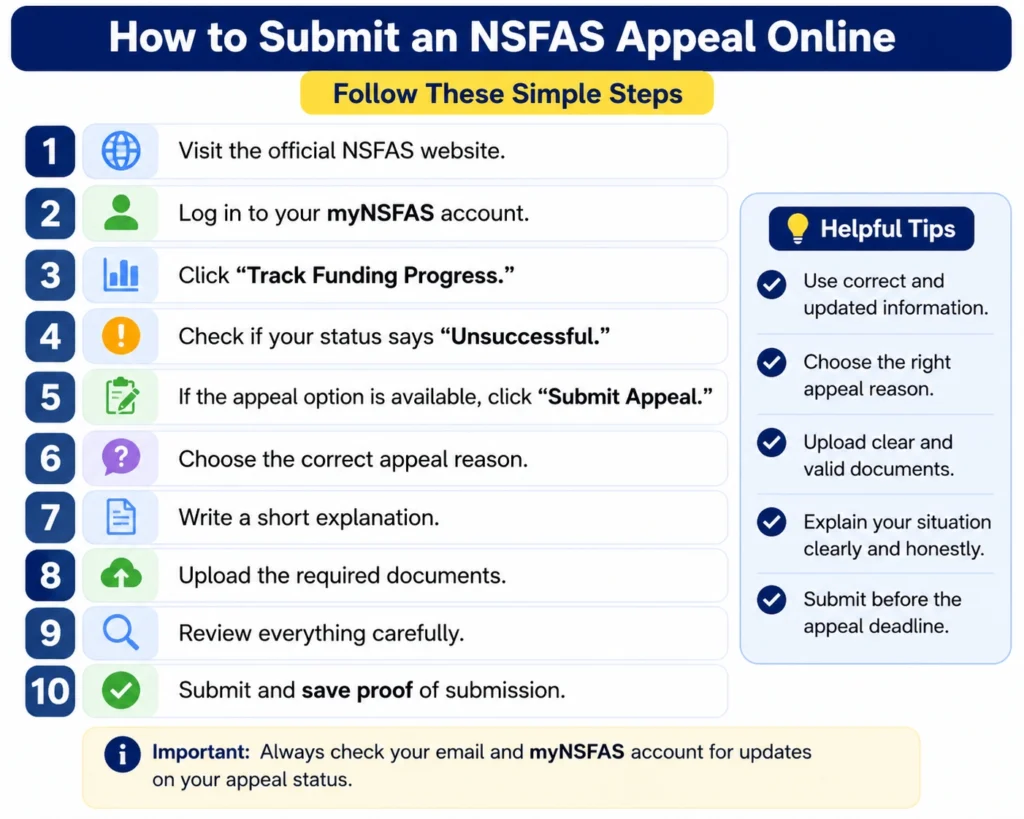
How to Submit an NSFAS Appeal process Online
Follow these steps:
Visit the official NSFAS website.
Log in to your myNSFAS account.
Click “Track Funding Progress.”
Check if your status says “Unsuccessful.”
If the appeal option is available, click “Submit Appeal.”
Choose the correct appeal reason.
Write a short explanation.
Upload the required documents.
Review everything carefully.
Submit and save proof of submission.
Tip: Take a screenshot after submitting your appeal. It can help if you need to follow up later.
Is There an NSFAS Appeal Form PDF?
In most cases, students do not need a separate NSFAS appeal process form PDF. Appeals are usually submitted online through the myNSFAS portal. If your university or TVET college asks for an extra form, get it from your financial aid office. Avoid downloading random appeal forms from unofficial websites.
Documents Needed for an NSFAS Appeal
Your documents depend on your rejection reason, but common documents include:
Make sure every document is clear and easy to read. Blurry photos are one of the easiest ways to weaken your appeal.
How to Write a Strong NSFAS Appeal Motivation
Keep your motivation short and factual. Use this simple structure:
First, say who you are and what you are studying.
Next, mention your rejection reason.
Then explain what changed or what went wrong.
After that, list the documents you uploaded.
End by asking NSFAS to review your case.
Do not write a long sad story. NSFAS needs facts and proof.
Simple Appeal Motivation Example
Dear NSFAS Appeal Committee,
My name is [Your Name], and I am studying [Course Name] at [Institution Name]. My funding application was unsuccessful because of [reason shown on portal]. I am appealing because [explain your real reason clearly]. I have uploaded supporting documents, including [list documents], to prove my situation. I kindly ask NSFAS to review my application again so I can continue my studies.
Thank you.
Kind regards,
[Your Name]
[ID Number]
[Student Number]
NSFAS Appeal Status Meaning
After submission, your status may change. Here is what it usually means:
| Status | Meaning |
| Submitted | Your appeal was sent |
| Pending | NSFAS has not finished checking it |
| Under Review | Your documents are being reviewed |
| Awaiting Documents | You must upload extra proof |
| Approved | Your appeal was successful |
| Rejected | NSFAS declined your appeal |
| Finalized | The NSFAS appeal process is complete |
Check your portal regularly. If NSFAS asks for extra documents, upload them as soon as possible.
How Long Does an NSFAS Appeal Take?
There is no exact time for every student. Simple appeals may be processed faster, while complex cases can take longer.
Delays can happen because of:
If your appeal is taking long, contact your financial aid office and check your myNSFAS account often.
What If Your Appeal Is Approved?
If your NSFAS appeal is approved, funding may not appear immediately. You may still need to:
Your university or TVET college must also update your registration details before some payments can move forward.
What If Your Appeal Is Rejected?
If your appeal is rejected, read the reason carefully. In many cases, the appeal decision is final for that cycle.
You can still:
Do not submit fake documents or pay someone who claims they can “fix” NSFAS. Only NSFAS can update your official status.
Tips to Avoid Appeal Rejection
Appeal as soon as the option appears
Choose the correct appeal reason
Upload documents in the right category
Make sure files are clear
Keep your motivation short
Do not upload expired or wrong documents
Check your portal every few days
Save your submission screenshot
Contact your financial aid office if institution records are wrong
FAQs About NSFAS appeal process
Conclusion:
The NSFAS appeal process gives rejected students a second chance, but you must act carefully. Check your rejection reason, prepare the right documents, write a clear motivation, and submit through myNSFAS on time. A strong appeal is simple: correct reason, clear proof, and no delays.