NSFAS Accommodation Allowance Explained for 2026 Students
Finding a safe and affordable place to live can be one of the hardest parts of student life. Rent, electricity, transport, food, and deposits can quickly become expensive.
The NSFAS accommodation allowance helps eligible university and TVET college students pay for approved housing while they study. However, receiving NSFAS funding does not mean that every room, flat, or private residence will automatically be covered.
Your accommodation normally needs to be approved or accredited. Your registration and funding status must also be confirmed, and a valid lease agreement may be required before payment can begin. This guide explains how the allowance works, who can receive it, how rent is paid, and what to do when there is a problem.
Learn how the NSFAS accommodation allowance works in 2026, who qualifies, what housing is covered, payment rules, common problems, and avoiding delays.
What Is the NSFAS Accommodation Allowance?
The NSFAS accommodation allowance is financial support provided to eligible students who need housing while studying at a public university or TVET college. It may cover approved accommodation such as:
A university or college residence
University-leased accommodation
An accredited private student residence
An approved room, flat, or shared student property
It is not extra spending money. The funding is meant specifically for the student’s approved accommodation costs.
NSFAS defines an allowance as money paid regularly to a university or TVET student for approved study-related costs other than tuition. Its 2026 bursary guidelines include accommodation or transport among the allowances that qualifying contact students may receive.
Quick Answer: How Does the Allowance Work?
Here is the process in simple terms:
You qualify for NSFAS funding.
You register at a public university or TVET college.
You choose approved or accredited accommodation.
Your registration, funding and housing details are checked.
You and the accommodation provider sign a valid lease.
NSFAS or your institution pays the approved accommodation cost.
For private accredited accommodation, NSFAS introduced direct monthly payments to accommodation providers for 2026. A confirmed funding status and a valid signed lease are required before providers can be included in the payment process.
Important 2026 Accommodation Allowance Update
Students should be careful when reading websites that give one fixed NSFAS accommodation amount for 2026. The official 2026 bursary guidelines do not provide a single rand amount for every student. They state that allowance costs will be published annually. NSFAS also said in May 2026 that it was still finalising the 2026 private accommodation rental rates.
This means your approved amount may depend on:
Helpful tip: Ask your institution’s financial aid or accommodation office for the rate that applies to your residence. Do not sign an expensive private lease based only on an amount shown on an unofficial blog.
Who Qualifies for the NSFAS Accommodation Allowance?
You may qualify when you:
Have been approved for NSFAS funding
Are registered for an eligible course at a public university or TVET college
Need accommodation to attend classes
Live in an approved or accredited property
Have submitted the required accommodation information
Have a valid lease agreement where required
Have not already been given a transport allowance for the same period
NSFAS rules state that a student can qualify for either accommodation or transport, not both. This rule applies to university and TVET college students. Final approval may still depend on the information submitted by your institution and accommodation provider.
Who May Not Qualify?
You may not receive the accommodation allowance when:
The 2026 guidelines state that distance university students taking less than 60% of a full credit load qualify only for learning materials. Distance students studying an equivalent full-time load may qualify for a personal-care allowance, but the guidelines do not list accommodation funding for them. Distance TVET students qualify for personal care only.
What Types of Accommodation Does NSFAS Cover?
This is housing owned or managed by your university or TVET college. The institution normally confirms your placement and sends the necessary information to NSFAS.
Some institutions rent buildings from private owners and use them as student residences. These properties are managed through the institution and must meet the required standards.
This includes privately owned student residences, rooms, apartments, or shared properties that have been approved by NSFAS or the institution.
NSFAS accreditation is important because the property is checked to see whether it is suitable for student living. Providers must register their properties and complete the required accreditation process.
A catered residence may include meals as part of its approved cost. The allowance structure can therefore differ from that of a student living in self-catered housing.
The 2026 guidelines explain that students in institution-catered accommodation receive a capped amount that includes accommodation, living and personal-care support.
Does NSFAS Pay for Unaccredited Private Accommodation?
Normally, no. NSFAS warns that students staying in unaccredited accommodation without permission from NSFAS or their institution may not receive an accommodation allowance. Providers who house funded students without following the required process may also not be paid.
A landlord saying that a property is “NSFAS-friendly” does not prove that it is accredited.
Before moving in, ask for:
How Much Does NSFAS Pay for Accommodation?
There is no reliable single monthly amount that applies to every student. The amount can differ according to the institution, accommodation category, approved rental rate, catering arrangement, and academic period.
Students should also understand that an allowance cap is a maximum, not an automatic cash payment. NSFAS pays the approved cost up to the applicable limit. It does not mean every student receives the maximum amount. For example, if an approved room costs less than the maximum rate, NSFAS will generally pay the approved rental cost rather than give the unused difference to the student.
As of the latest official information reviewed for this guide, NSFAS was still finalising 2026 private accommodation rental rates. Students should therefore confirm the current amount directly with their institution or NSFAS.
How Is the Accommodation Allowance Paid?
The payment method depends on the type of housing.
Private Accredited Accommodation
For 2026, NSFAS accommodation payments for eligible university students in private housing are being paid directly to accredited accommodation providers. NSFAS issues monthly payment schedules, while providers must ensure that the student’s funding and lease details have been verified.
University Residence
NSFAS usually pays the institution, and the amount is credited to the student’s account or residence charges.
TVET College Accommodation
Payment may be made through an approved NSFAS payment channel or directly to the college where the college provides its own student housing.
Students should not assume that accommodation money will always be deposited into their personal bank accounts.
Can a Landlord Ask for a Deposit or Top-Up Payment?
An approved private accommodation provider should not ask an NSFAS-funded student to pay a deposit, rent top-up, or other accommodation fee covered by the standard lease. The NSFAS standard lease states that the provider may not require the student to pay a deposit, top-up, or rent while waiting for NSFAS payment. It also says that rent is paid directly to the provider on the student’s behalf.
NSFAS has also publicly warned that beneficiaries are not required to pay student accommodation fees.
Do not hand over money simply because a landlord says NSFAS is late. First contact your institution’s accommodation or financial aid office and confirm whether the property and lease are correctly recorded.
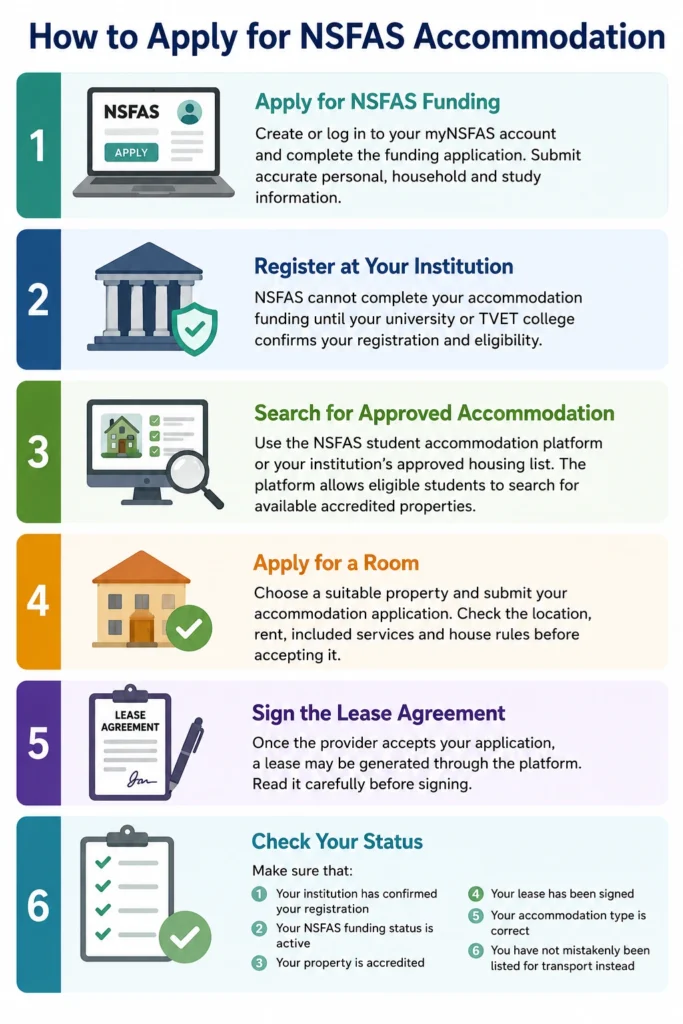
How to Apply for NSFAS Accommodation
Apply for NSFAS Funding
Create or log in to your myNSFAS account and complete the funding application. Submit accurate personal, household and study information.
Register at Your Institution
NSFAS cannot complete your accommodation funding until your university or TVET college confirms your registration and eligibility.
Search for Approved Accommodation
Use the NSFAS student accommodation platform or your institution’s approved housing list. The platform allows eligible students to search for available accredited properties.
Apply for a Room
Choose a suitable property and submit your accommodation application. Check the location, rent, included services and house rules before accepting it.
Sign the Lease Agreement
Once the provider accepts your application, a lease may be generated through the platform. Read it carefully before signing.
Check Your Status
Make sure that:
1.Your institution has confirmed your registration
2.Your NSFAS funding status is active
3.Your property is accredited
4.Your lease has been signed
5.Your accommodation type is correct
6.You have not mistakenly been listed for transport instead
Once the checks are complete, NSFAS can begin paying the approved provider.
Common Reasons Accommodation Payments Are Delayed
Your institution may not have submitted your registration data, or the information may contain an error.
A missing signature, wrong rental date, incorrect student number, or mismatched ID details can stop payment.
NSFAS may refuse to pay an unapproved provider, even when the student has already moved in.
A student who needs accommodation may accidentally be recorded as receiving transport. NSFAS identified the misclassification of students as transport recipients as one of the issues affecting 2026 accommodation payments.
The landlord’s banking, tax, property or accreditation information may still need to be verified.
Moving without updating your details can cause payments to continue going to the old provider or stop altogether.
What to Do When Your Accommodation Payment Is Late
Follow these steps:
Ask your accommodation provider whether other NSFAS students have been paid.
Check that your lease is signed and active.
Confirm the property’s accreditation.
Visit your institution’s financial aid or accommodation office.
Ask whether your registration and accommodation claim were submitted.
Check that you are listed for accommodation, not transport.
Keep screenshots, emails, leases and reference numbers.
Contact NSFAS when the institution cannot resolve the issue.
Current NSFAS support channels include email, WhatsApp and USSD. The official contact page lists info@nsfas.org.za, WhatsApp +27 63 093 5671, and USSD *120*67327#.
Quick tip: Ask for a case or reference number whenever you report a problem. It makes follow-ups much easier.
Can You Move to Another Residence During the Year?
You may be able to move, but do not move first and ask questions later. You should:
NSFAS states that students who leave a registered property must notify the scheme. Its accommodation rules also warn that moving without prior approval may make the student responsible for rent at the new property.
Where a student changes accommodation during the year, the available funding may also be limited to the remaining balance under the applicable cap.
Easy Tips to Avoid Accommodation Problems
Confirm Accreditation Before Moving In
Do not rely only on the landlord’s word. Check with NSFAS or your institution.
Read the Whole Lease
Check the rental period, house rules, included services and cancellation terms.
Keep Copies of Everything
Save your lease, acceptance email, proof of registration and messages from the provider.
Use Matching Personal Details
Your name, ID number and student number should match across your myNSFAS account, institution and lease.
Report Changes Quickly
Update NSFAS when you move, deregister, change institutions or leave the property.
Do Not Pay Unapproved Fees
Ask your financial aid office before paying a deposit, top-up, or rent claimed to be outstanding.
Frequently Asked Questions
Conclusion:
The NSFAS accommodation allowance can make student life much easier, but only when the correct process is followed.
Before moving into any property, confirm that it is accredited, check the approved rental amount, and make sure your lease is valid. Remember that accommodation and transport cannot normally be claimed together. You should also avoid paying deposits or top-ups without first checking with NSFAS or your institution.
Most accommodation problems start with missing documents, incorrect registration information, or unapproved housing. Checking these details early can save you weeks of stress and help you focus on your studies.