Allowance Payment Dates NSFAS: Monthly Allowance Schedule
For many South African students, NSFAS allowances are not extra money. They are the monthly support used for rent, food, transport, books, and basic personal needs. That is why students search for Allowance Payment Dates NSFAS 2026 as soon as the academic year starts.
In 2026, NSFAS started the allowance process with early upfront payments. Universities received upfront allowance funding at the beginning of February, while TVET college payment activity was linked to registration data and revised disbursement dates. NSFAS confirmed that early-year payments were meant to help qualifying students begin the academic year with financial support. Check NSFAS Allowance payment dates 2026, including university and TVET cycles, February payments, delay reasons, and status check steps in one guide. Get info.
When Are NSFAS Allowance Payments in 2026?
NSFAS Allowance Payment Dates started in early February 2026. Upfront payments were completed around 2 February 2026, while TVET college students had allowance disbursements scheduled around 13 February and 27 February because some TVET registration periods were extended.
After the first payment, students generally follow monthly or institution-based payment cycles. The exact date can differ depending on your university, TVET college, bank verification, and whether your registration data has been submitted correctly.
NSFAS Allowance Payment Dates 2026 Table
Some institutions publish their own allowance cycle dates. For example, UKZN listed the following 2026 NSFAS Allowance Payment Dates cycle dates for its students. Students at other institutions should still confirm their own campus schedule.
| Cycle | Payment Date |
|---|---|
| Cycle 1 | 11 February 2026 |
| Cycle 2 | 2 March 2026 |
| Cycle 3 | 7 April 2026 |
| Cycle 4 | 4 May 2026 |
| Cycle 5 | 1 June 2026 |
| Cycle 6 | 6 July 2026 |
| Cycle 7 | 3 August 2026 |
| Cycle 8 | 31 August 2026 |
| Cycle 9 | 5 October 2026 |
| Cycle 10 | 2 November 2026 |
These dates are useful as a payment-cycle example, but they should not be treated as one national date for every student. NSFAS releases funds according to verified data, and institutions may process allowances on different internal timelines.
February 2026 NSFAS Allowance Payment
February is usually the biggest allowance month because it includes the start-of-year payment process. NSFAS confirmed that R3.6 billion was disbursed to universities for allowance payments, while R679 million was disbursed to TVET colleges for tuition payments. TVET allowance payments were then scheduled for 13 February and 27 February 2026.
This means February payments were not the same for everyone. Some students received money earlier, while others waited because their institution still needed to submit or correct registration data.
What Allowances Does NSFAS Pay?
NSFAS allowances are designed to support essential student needs. The official 2026 bursary guidelines state that university students may receive support for learning materials, living allowance, and either accommodation or transport.
| Allowance Type | Main Purpose |
|---|---|
| Learning material allowance | Books, academic material, or learning devices |
| Living allowance | Food and day-to-day student expenses |
| Accommodation allowance | Approved residence or accredited housing |
| Transport allowance | Travel to and from campus |
| Personal care allowance | Hygiene and basic personal needs |
NSFAS also makes it clear that students may qualify for either transport or accommodation allowance, not both.
University NSFAS Allowances 2026
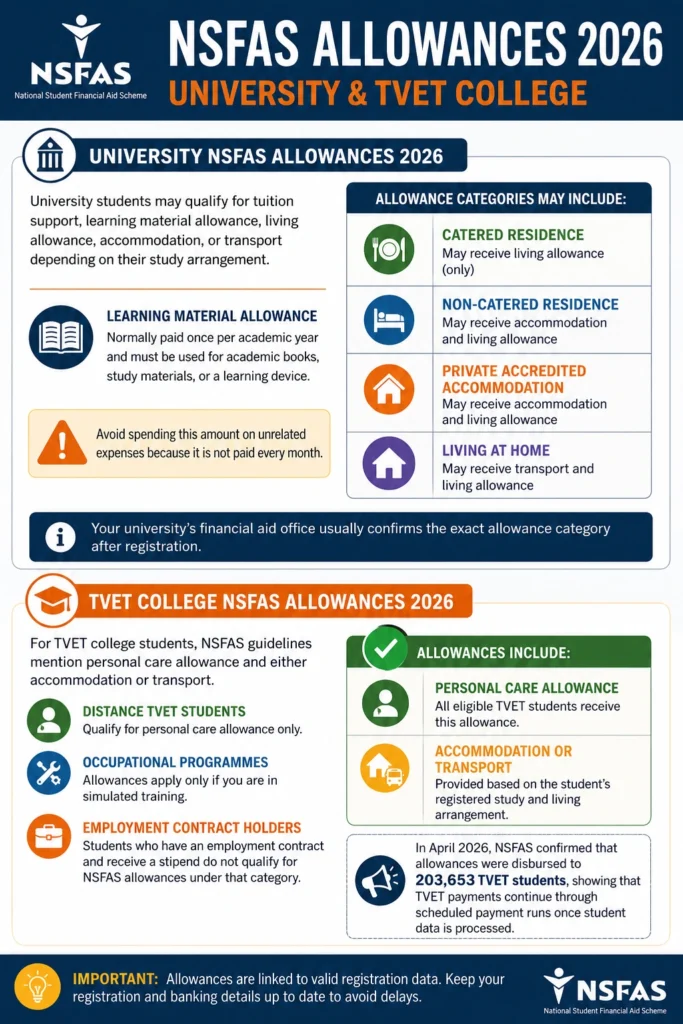
University students may qualify for tuition support, learning material allowance, living allowance, accommodation, or transport depending on their study arrangement.
The learning material allowance is normally paid once per academic year and must be used for academic books, study materials, or a learning device. Students should avoid spending this amount on unrelated expenses because it is not paid every month.
Students in catered residences, non-catered residences, private accredited accommodation, and students living at home may receive different allowance combinations. Your university’s financial aid office usually confirms the exact allowance category after registration.
TVET College NSFAS Allowances 2026
For TVET college students, NSFAS guidelines mention personal care allowance and either accommodation or transport. Distance TVET students qualify for personal care allowance only. TVET students registered for occupational programmes may qualify for allowances only if they are in simulated training. Students who have an employment contract and receive a stipend do not qualify for NSFAS allowances under that category.
TVET students must also remember that allowances are linked to valid registration data. In April 2026, NSFAS confirmed that allowances were disbursed to 203,653 TVET students, showing that TVET Allowance Payment Dates continue through scheduled payment runs once student data is processed.
Who Qualifies for NSFAS Allowances?
NSFAS funding is for eligible students at public universities and TVET colleges. TVET applicants generally qualify if their combined gross family income is within the required threshold and they are admitted or have a firm offer at a public TVET college.
Students must also meet registration, academic, and funding rules. The 2026 NSFAS guidelines explain that students must be registered for an approved NSFAS-funded qualification and must meet financial and academic criteria before funding is confirmed.
Why NSFAS Allowance Payments Get Delayed
Most NSFAS allowance delays happen because one part of the payment process is incomplete. A student can be approved but still wait for money if registration data has not been submitted correctly.
Common reasons include:
Late registration by the student.
Institution has not submitted registration data.
Incorrect banking details.
Bank account not in the student’s name.
Accommodation details still under review.
Missing documents.
Course or qualification changes.
NSFAS verification backlog.
NSFAS guidelines require institutions to submit accurate and complete registration data. If that data is incorrect or incomplete, payment can be delayed.
How to Check NSFAS Allowance Payment Status
Students should check their Allowance Payment Dates and status through the myNSFAS portal and their institution’s financial aid office.
Follow these steps:
If your status says “disbursed,” the payment has been released, but it may still take a few working days to reflect in your bank account.
What Students Must Do to Get Paid on Time
To reduce payment delays, students should complete their part of the process early.
| Student Action | Why It Matters |
|---|---|
| Register early | Late registration can delay allowance release |
| Update banking details | Incorrect details can block payment |
| Use your own bank account | Third-party accounts may be rejected |
| Submit documents clearly | Avoids verification problems |
| Check myNSFAS weekly | Helps catch issues early |
| Contact financial aid office | Confirms registration data submission |
| Keep proof of registration | Helps with payment queries |
Students should also keep contact details updated, meet academic progression rules, and use NSFAS allowances only for their intended educational purposes.
How to Manage Your NSFAS Allowance
When your allowance arrives, divide it before spending. NSFAS money is meant to support your studies, so rent, transport, food, and study needs should come first.
| Allowance Money | Best Use |
|---|---|
| Accommodation | Rent or residence payment |
| Transport | Taxi, bus, train, or travel card |
| Learning material | Books, stationery, device, or study tools |
| Living allowance | Food and daily essentials |
| Personal care | Toiletries and hygiene needs |
A smart habit is to save a small emergency amount every month. Even R50 to R200 can help if the next allowance is delayed.
FAQs About Allowance Payment Dates Appeal?
Conclusion:
Allowance Payment Dates NSFAS 2026 are important because students depend on this support for study and daily living costs. The 2026 payment process started with early February upfront payments, followed by monthly or institution-based allowance cycles.
Students should not rely only on a date table. The safest approach is to register early, keep banking details updated, check myNSFAS regularly, and confirm that the institution submitted registration data. When all details are correct, NSFAS Allowance Payment Dates are more likely to arrive without unnecessary delays.