NSFAS Payment Dates for TVET Colleges 2026: TVET Schedule
NSFAS payment dates for TVET colleges in 2026 are important for students who depend on their funding to manage transport, accommodation, food, and daily study needs. Every year, many TVET students ask the same question: when will NSFAS pay?
The answer is not always one fixed date for every student. NSFAS payments depend on the official payment cycle, your college’s registration data, your banking verification, and whether your student record is complete.
This guide covers only NSFAS payment dates for TVET colleges in 2026. Allowance amounts, categories, eligibility, and rules are in a separate guide for details,
Quick Answer: When Will NSFAS Pay TVET Students in 2026?
NSFAS started the 2026 TVET payment process at the beginning of the academic year. TVET tuition upfront payments were planned for 31 January 2026, while the first TVET allowance disbursement was expected from early February.
Later updates showed that TVET student allowance disbursements were adjusted to 13 February 2026 and 27 February 2026 because some TVET registration periods were extended.
This means TVET students should not rely on only one date. Your payment can arrive later if your college submits registration data late or if NSFAS still needs to verify your details.
NSFAS TVET Payment Dates 2026 Table
| Payment Process | Date |
|---|---|
| TVET tuition upfront payment | 31 January 2026 |
| Upfront payment process begins | 1 February 2026 |
| Upfront payments completed | 2 February 2026 |
| Planned first TVET allowance run | 7 February 2026 |
| Revised TVET allowance payment | 13 February 2026 |
| Second TVET allowance payment | 27 February 2026 |
| March payment cycle | 2 March 2026 |
| April TVET payment run | 17 April 2026 |
These dates help students understand the main payment activity for the 2026 academic year. However, the actual date your money reflects may differ depending on your bank and your college’s data submission.
February 2026 TVET Payment Dates Explained
February is usually the most important payment month for TVET students because it is the beginning of the academic year. Registration, student verification, and allowance processing all happen close together.
For 2026, NSFAS planned early TVET payment activity in February. The first payment process was expected around 7 February, but revised dates later confirmed payment activity around 13 February and 27 February.
The change happened because some Payment dates for TVET colleges had extended registration periods. When registration is extended, NSFAS needs updated and correct student data before payment can be released.
Does NSFAS Pay TVET Students Every Month?
TVET students may receive NSFAS payments during approved academic months, depending on their programme type, registration status, and verified funding record.
Some students are on semester programmes, while others may be on trimester-based courses. This means not every TVET student will follow the exact same payment rhythm.
In general, students should check their myNSFAS account and college bursary office updates during every payment cycle. The official date is only useful if your registration data is already complete.
How TVET Payment Cycles Work
NSFAS does not simply send money to every student at once. The payment process follows a step-by-step system.
First, the student must be funded or provisionally funded. After that, the TVET college must submit registration data to NSFAS. NSFAS then verifies the information, checks whether the student is eligible for payment, and processes the allowance through the approved payment method.
If the college sends incomplete or late data, the student may miss the first payment run and move to a later cycle.
Semester and Trimester TVET Payment Timing
Payment dates for TVET colleges do not all follow the same academic calendar. This is one reason payment timing can differ from student to student.
Semester Programmes
Semester-based students usually receive payments linked to the first and second semester. Their payment timing depends on successful registration for that semester.
Trimester Programmes
Trimester-based students may need updated registration data for each trimester. If the college delays trimester data, the payment can also be delayed.
Other TVET Programme Types
Some occupational or specialised TVET programmes may follow different payment rules. Students in these programmes should confirm their payment cycle with the college bursary office.
Why NSFAS TVET Payments Get Delayed
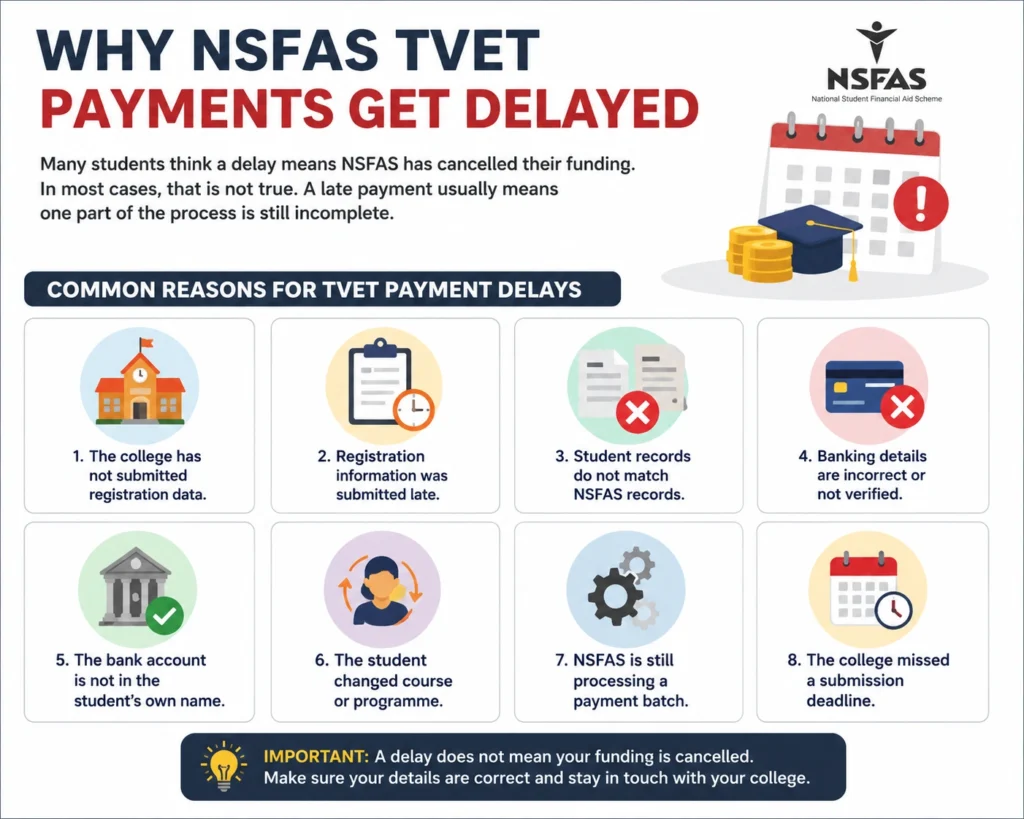
Many students think a delay means NSFAS has cancelled their funding. In most cases, that is not true. A late payment usually means one part of the process is still incomplete.
Common reasons for TVET payment delays include:
The college has not submitted registration data.
Registration information was submitted late.
Student records do not match NSFAS records.
Banking details are incorrect or not verified.
The bank account is not in the student’s own name.
The student changed course or programme.
NSFAS is still processing a payment batch.
The college missed a submission deadline.
If your payment is late, the first thing to check is your registration data status.
How to Check NSFAS TVET Payment Status
Students should check their status through the myNSFAS portal and also follow updates from their TVET college.
Follow these steps:
Checking once or twice a week during payment periods is enough. Daily checking will not speed up the process, but regular monitoring helps you catch problems early.
What NSFAS Payment Status Messages Mean
| Status | Meaning |
|---|---|
| Approved | Your funding has been accepted |
| Processing | NSFAS is checking your details |
| Awaiting registration data | Your college must submit or correct your registration |
| Disbursed | Payment has been released |
| Pending documents | More information is required |
| Rejected | Funding was not approved |
The most important status for delayed payments is “awaiting registration data.” This usually means your college still needs to send or fix your information.
What to Do If Your NSFAS TVET Payment Is Late
If your payment does not arrive on the expected date, do not panic immediately. Use a clear process. First, check your myNSFAS status. If the status says “disbursed,” wait a few working days for the bank to reflect the money.
If the status says “processing,” NSFAS may still be verifying your payment. If the status says “awaiting registration data,” contact your TVET bursary office and ask whether your registration has been submitted.
If the delay continues for more than two weeks, submit a formal NSFAS query. Include your ID number, student number, college name, registration proof, and screenshots of your status.
How to Avoid TVET Payment Problems
Students can reduce the risk of late payment by preparing early.
| Action | Why It Helps |
|---|---|
| Register early | Gives your college time to submit data |
| Use your own bank account | Prevents payment rejection |
| Keep phone and email updated | Helps you receive NSFAS messages |
| Check myNSFAS weekly | Helps identify problems early |
| Save registration proof | Useful for follow-ups |
| Visit the bursary office early | Confirms your data was submitted |
Do not wait until payment day to fix account or registration issues. Most delays begin before the payment date arrives.
NSFAS Payment dates for TVET colleges
Conclusion:
NSFAS payment dates for TVET colleges in 2026 depend on more than the official calendar. Important payment activity started in February, with revised Payment dates for TVET colleges around 13 February and 27 February. Later payment cycles continued after registration and verification data was processed.
For students, the best approach is to register early, keep banking details updated, check myNSFAS regularly, and stay in contact with the TVET bursary office. If your payment is delayed, check whether your college has submitted your registration data before assuming your funding has been cancelled.